


About residency programme
One of the pillars of BGSW’s programme is our artist-in-residence initiative, which is closely intertwined with the institution’s mission and day-to-day activities. Making the most of our unique location, we want our residencies to serve multiple purposes – to be a place for focused work, but also for repose. Residencies centred on repose are an important part of our mission: sharing our exceptional surroundings. Open calls for residencies are announced whenever possible.
As part of programmes connected to our ongoing activities, creative residencies are offered to invited artists. The thematic line developed from 2025 onward is “Circulations.”
As in all our projects, we focus primarily on the creative process rather than solely on the final outcome. We welcome participants from the field of visual arts and related disciplines.


Residency Participants
Alicja Wysocka
Alicja Wysocka is an interdisciplinary visual artist working across performance, video installation, site-specific practice and choreographed social situations. She graduated from the University of the Arts Poznań and the Hochschule für Bildende Künste Städelschule in Frankfurt am Main, where she studied in Haegue Yang’s class. Her practice explores community, the commons, practices of rest and alternative models of social, economic and artistic organisation. Her projects are often developed in collaboration with local communities and draw on ritual, water, bathing and spa cultures, embodied memory and collective practices of care. Her long-term initiatives focusing on cooperation and cooperative structures include “Collective Capital”, the First International Congress of Art Cooperatives and the “Cooperative Seminar”. She has undertaken residencies at the Jan van Eyck Academie, MMCA Seoul, Akademie Schloss Solitude, Cittadellarte and Jatiwangi Art Factory. Her work has been presented at Schirn Kunsthalle Frankfurt, the Museum of Modern Art in Warsaw, the Ujazdowski Castle Centre for Contemporary Art and Triennale Milano. She has received grants from DAAD, the City of Warsaw and the Polish Ministry of Culture and National Heritage. She lives nomadically and works internationally.
The residency is organised as part of the “Kurort Ustka” project, co-financed by the Minister of Culture and National Heritage under the “Visual Arts 2026” programme.
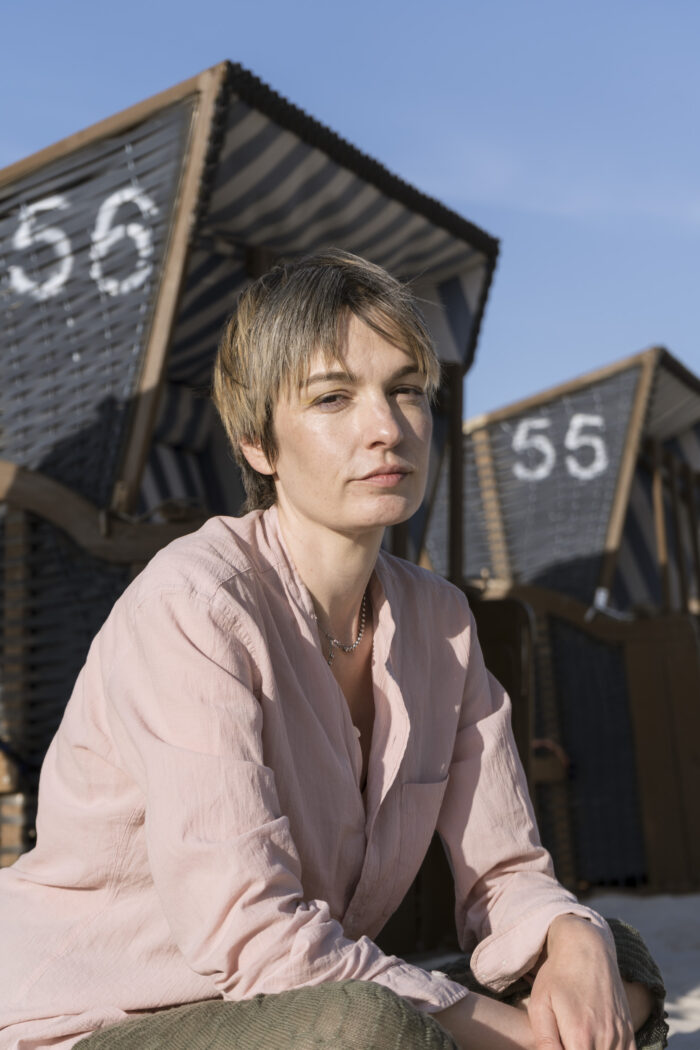
Anca Benera & Arnold Estefan
Anca Benera & Arnold Estefan are collaborators who have worked together since 2011, currently based in Vienna and Bucharest. Their work in installation, video and performance uses research-based methodologies to reveal the invisible patterns that lie behind certain historical, social, or geopolitical narratives. Their recent work investigates the phenomenon of man-made landscapes around the world, where the making and marking of landscape (as a form of spatial modification) goes hand in hand with heightened state violence and the overexploitation of resources. They are the recipients of The Birgit Jürgenssen Prize 2022, awarded by The Austrian Federal Ministry for Education, Arts and Culture and the Academy of Fine Arts Vienna and currently they are holding the position of Creative Fellows at UCL’s, Postsocialist Art Centre in London. They completed an artist residency at the Baltic Gallery of Contemporary Art and took part in the exhibition Coalition of Waters (2025).

Ania Nowak
Ania Nowak (b. 1983) works in the field of choreography, exploring the limits of the body and language, and the potential of desire, fragility and anger as tools for social transformation. She creates performances, video works, installations and texts addressing relations of care and co-existence in times of crisis, while redefining notions of pleasure, illness, pain, intimacy and accessibility beyond binary structures and exclusion.
She collaborates with alternative educational programmes across Europe, including Kem School in Warsaw and the School of Kindness in Sofia.
Her works have been presented, among others, at HAU Hebbel am Ufer, Berlinische Galerie, KW Institute for Contemporary Art, Sophiensaele (Berlin); Nowy Teatr (Warsaw); Kiasma (Helsinki); La Casa Encendida (Madrid); MQ Vienna; Kunsthalle Münster; and at the 14th Baltic Triennial and 12th Göteborg Biennial.
Selected solo exhibitions include: A Kiss Doesn’t Kill (Museum of Modern Art, Warsaw, 2023); Ill Delights (Galerie Wedding, Berlin, 2023); Can You Die of a Broken Heart? (Ujazdowski Castle Centre for Contemporary Art, 2018); and Matters of Touch (Arts Santa Mònica, Barcelona, 2017).
She lives and works in Berlin.
Dominik Styk
Dominik Styk (born in Banská Bystrica in 1996) is a Slovak artist working across sculpture, installation and performance. He studied scenography for alternative and puppet theatre at the Academy of Performing Arts in Prague and graduated from the Time-Based Media programme at the University of Fine Arts Hamburg, where he studied under Michaela Melián and Kader Attia. His practice incorporates textiles, wearable objects and materials such as clay, wax and leather. He explores relationships between the body and its surroundings, processes of identity formation, and the intersections of illusion, perception and scenography. He has undertaken study residencies at the Academies of Fine Arts in Nuremberg and Vienna. His work has been presented at institutions including Gesellschaft für Aktuelle Kunst in Bremen, Kunstverein Schwerin, Kunstforum Rottweil, the National Gallery Prague and the Zlín Youth Salon. He lives and works in Hamburg.
Dominik Styk’s residency was made possible with the support of the International Visegrad Fund and Culture Moves Europe, a programme funded by the European Union and implemented by the Goethe-Institut.
This work was produced with the financial assistance of the European Union. The views expressed herein can in no way be taken to reflect the official opinion of the European Union.
Elżbieta Jabłońska
Elżbieta Jabłońska – Artystka wizualna, podejmująca ironiczną grę z przypisywanymi jednostce rolami społecznymi, mechanizmami funkcjonowania instytucji sztuki, poddająca refleksji zaangażowanie społeczne w obszarze sztuki. Jej twórczość wpisywana jest często w obręb sztuki feministycznej czy postfeministycznej. Tworzy głównie instalacje, fotografie, performance oraz działania czasowo-przestrzenne. Traktuje dzieło sztuki jako obiekt relacyjny, którego sens i znaczenie może podlegać zmianom i negocjacji. Aktualnie koncentruje się na gestach artystycznych, które zachęcają do działania, do budowania chwilowej wspólnoty, tworzenia pola wzajemnej komunikacji i porozumienia rezygnując tym samym z produkcji materii, a czasem również z własnego autorstwa. Profesora na Wydziale Sztuk Pięknych Uniwersytetu Mikołaja Kopernika w Toruniu. Brała udział w wielu wystawach zbiorowych i indywidualnych. Laureatka nagrody Spojrzenia (2003 r.) oraz Nagrody im. Katarzyny Kobro (2023 r.). Prezeska Fundacji W788.

Eszter Metzing
Eszter Metzing was born in 1992 in Pécs, Hungary. She graduated from the Graphic Art programme at the Hungarian University of Fine Arts in Budapest in 2018. Her practice focuses on phenomena related to sensation and memory, exploring individual and social-psychological aspects of female experience. She creates textile installations and objects, often combining materials such as latex, borosilicate glass, glass and fabrics. Since 2022, she has been a member of the Young Artists’ Association and the Association of Hungarian Graphic Artists. Since 2021, she has been represented by Inda Gallery in Budapest, where she held two solo exhibitions, in 2021 and 2024. She regularly participates in group exhibitions in Hungary and made her debut at ISBN Gallery in 2021 as an artist duo with Stella Koleszár, also known as lutum. She is also a member of Art Quarter Budapest (aqb), a contemporary art centre and artist community.
Eszter Metzing’s residency and project at BGSW are supported by the Wacław Felczak Foundation and co-funded by the European Union through the Culture Moves Europe programme.
This work was produced with the financial assistance of the European Union. The views expressed herein can in no way be taken to reflect the official opinion of the European Union.
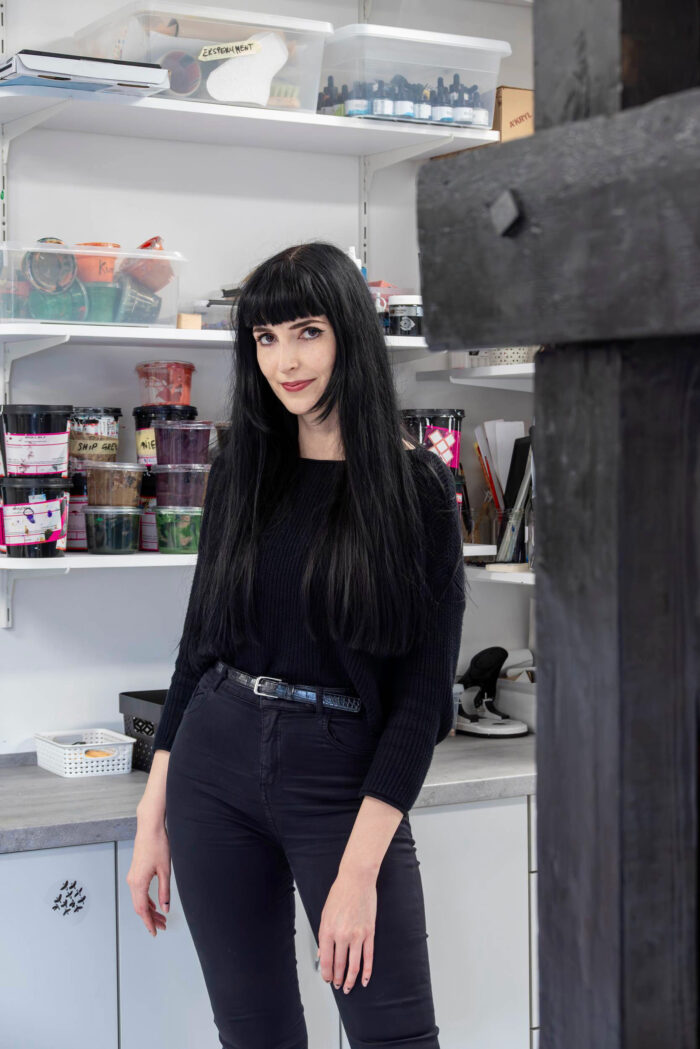
Ewelina Figarska
Ewelina Figarska creates sculptural objects, experimental and prose writings, as well as broadcasts. Her work explores the intersections between the everyday and the uncanny, literature and visual art. She is also deeply engaged with the body and multisensory ways of processing reality. She materialises her texts through interdisciplinary means. A graduate of the Academy of Fine Arts in Łódź and a directing student at the Academy of Theatre Arts in Kraków (2022/23), she is the author of objects, exhibitions, and experimental texts. In 2024/25 she is teaching at the Guest Artistic Studio at the Faculty of Design, Academy of Fine Arts in Warsaw. Through her radio programme Cebula, she focuses on conversation as a creative method and organises open calls for voice and sound recordings. Within the collective Garaż, she co-explores spaces for notes, alternative communication, nothings, and useful non-utilities. She is the author of the book I Am a Little Fruit Fly, I Came to Look at You (słowo/obraz terytoria, 2025).

Jagoda Dobecka
Jagoda Dobecka is a visual artist, researcher and curator. She graduated in painting from the Eugeniusz Geppert Academy of Art and Design in Wrocław and is currently a doctoral candidate at the Jan Matejko Academy of Fine Arts in Kraków. Her practice addresses mourning, longing and loss, exploring ways of collectively experiencing liminal states and developing gestures that restore a sense of safety and community. She is interested in art as a practical tool for building and expanding relationships and challenging existing social hierarchies. Performative dinners are an important format in her work, creating spaces for encounters, the exchange of experiences and collectively moving through processes of loss. She has participated in residency programmes at MeetFactory in Prague, KAIR Košice, Goyki 3 in Sopot and ssesi.space in Brno. Her work has been presented at BWA Wrocław, Zachęta – National Gallery of Art, Prague City Gallery and the Starak Family Foundation. She has received scholarships from the Polish Ministry of Culture and National Heritage and the Mayor of Wrocław. She was a finalist in the 13th Geppert Competition and was nominated for the WARTO Award in the visual arts category. She lives and works between Wrocław and Prague.
The residency is organised as part of the “Kurort Ustka” project, co-financed by the Minister of Culture and National Heritage under the “Visual Arts 2026” programme.
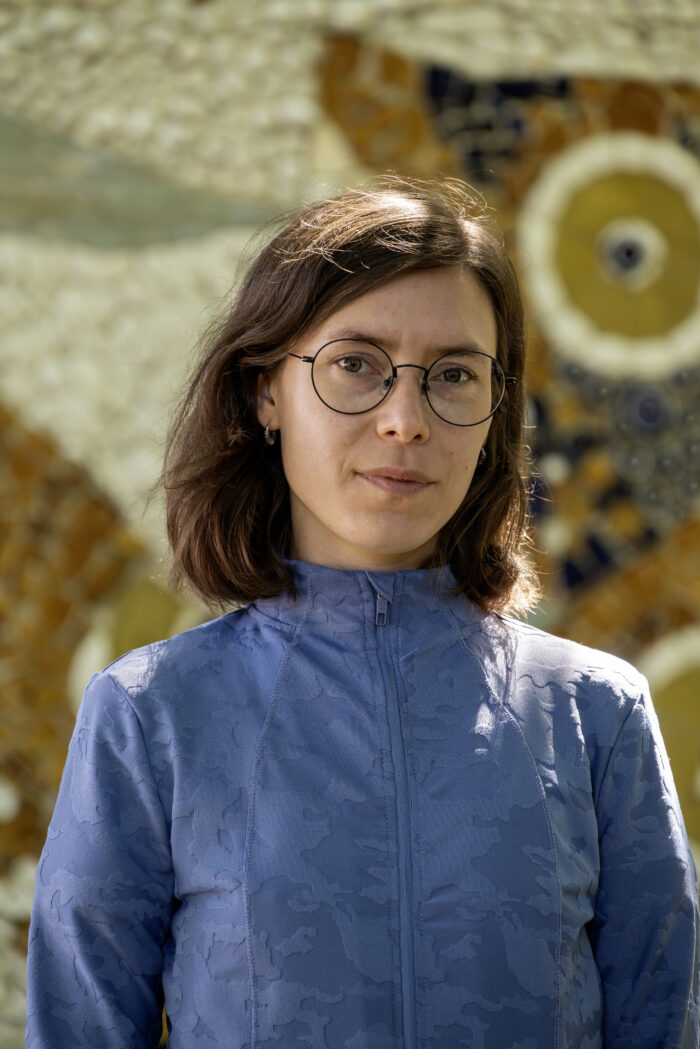
Jan Baszak
Jan Baszak (born in Szczecin in 1994) is a visual artist working across sculpture, installation, stage design, textile art and research-based practice. He graduated from the University of the Arts Poznań and the Academy of Art in Szczecin, where he is currently pursuing a PhD. Using animal-derived materials, old textiles and found objects, he explores relationships between human and non-human beings, drawing on queer theory, posthumanism and the agency of matter. He creates layered installations centred on melancholy, fantasy, the abject and the affirmation of otherness. His work has been presented at Zachęta – National Gallery of Art, the Ujazdowski Castle Centre for Contemporary Art, ZAMEK Culture Centre in Poznań and the Central Museum of Textiles in Łódź. He lives and works between Szczecin, Warsaw and Berlin and is represented by WHOISPOLA Gallery.
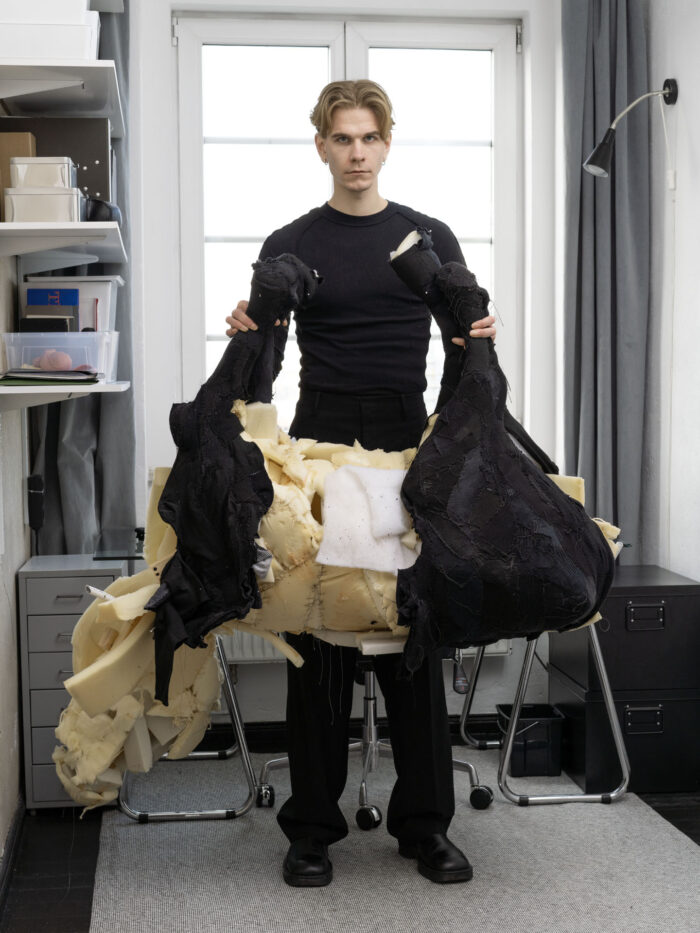
Lukas Hofmann
Lukas Hofmann (born in Prague in 1993) is a Czech artist working primarily with performance, as well as curating, fashion and styling. Using choreography, the body and carefully constructed sensorial atmospheres, his practice explores vulnerability, heightened presence and the relationships formed within temporary communities. He studied at the Academy of Fine Arts and the Academy of Arts, Architecture and Design in Prague, as well as at the Korea National University of Arts in Seoul. In 2018, he received the Jindřich Chalupecký Award. His work has been presented at the National Gallery Prague, SAVVY Contemporary in Berlin, Art in General in New York, Statens Museum for Kunst in Copenhagen, Cabaret Voltaire in Zurich and Wiener Festwochen.
The residency was made possible with the support of the International Visegrad Fund.
Magdalena Chowaniec
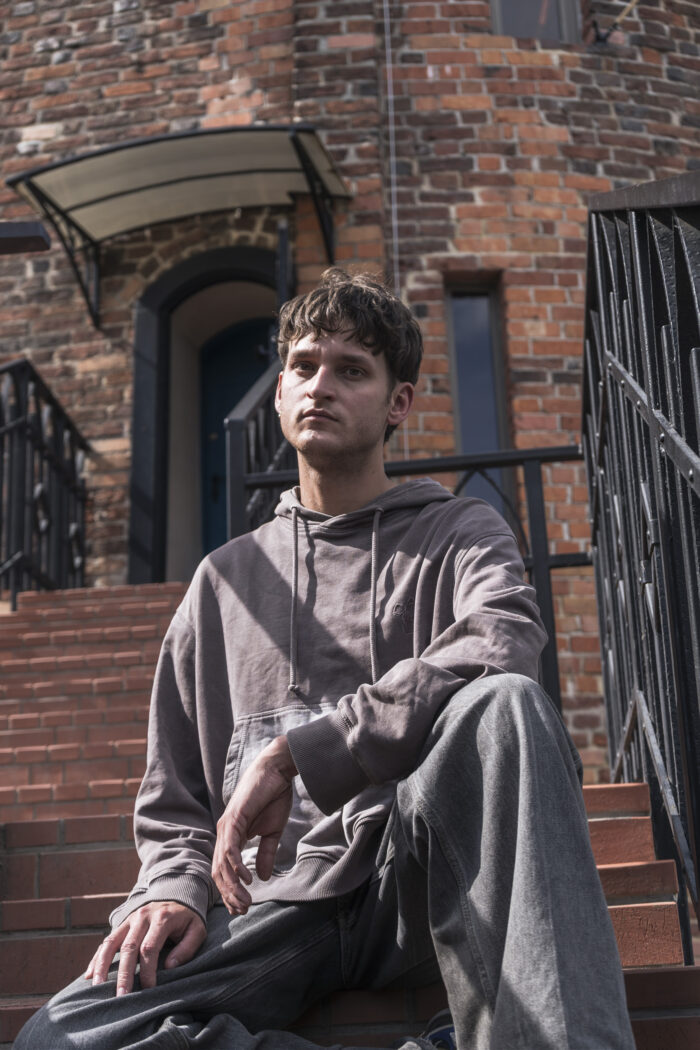
Magdalena Chowaniec is a choreographer, performer, musician, curator, cultural mediator and artistic researcher. She has a background in classical ballet and holds a master’s degree from Anton Bruckner Private University in Linz, where she wrote a thesis on bodily empathy. Her practice explores choreographic and somatic methods as tools of gentle resistance, socio-political reorganisation and both individual and collective transformation. She has collaborated with artists including Amanda Piña, Alex Baczyński-Jenkins, Michael Laub, Oleg Soulimenko and Ulduz Ahmadzadeh. Her own projects have been presented at ImPulsTanz and Wiener Festwochen, as well as at Kampnagel in Hamburg and Sophiensäle in Berlin. In 2023 and 2025, she choreographed two opera productions for the Vienna State Opera. Since 2015, she has performed as part of the rave duo Mermaid & Seafruit, created with musician Markus Steinkellner. From 2019 to 2020, she worked as an artistic researcher at the doctoral school of the University of Music and Performing Arts Graz. From 2021 to 2024, she was a curator of urban projects and cultural mediator at Tangente St. Pölten. She lives and works in Austria.
The residency is organised as part of the “Kurort Ustka” project, co-financed by the Minister of Culture and National Heritage under the “Visual Arts 2026” programme.
Maja Demska
Maja Demska (born in 1992) is an artist, poet and curator. Her practice examines the presence and role of data, diagrams and other forms of knowledge visualisation in art. She is the author of the poetry collection Pretending to Be Human, published by Girls and Queers to the Front in 2022, and the founder of Groszowe sprawy, an independent artist-run space that operated at the Namysłowska Market in Warsaw between 2018 and 2020. She comes from Sopot. She lives in an apartment block.
Residency was part of the exhibition “Within Words”.
Mariia Bakalo
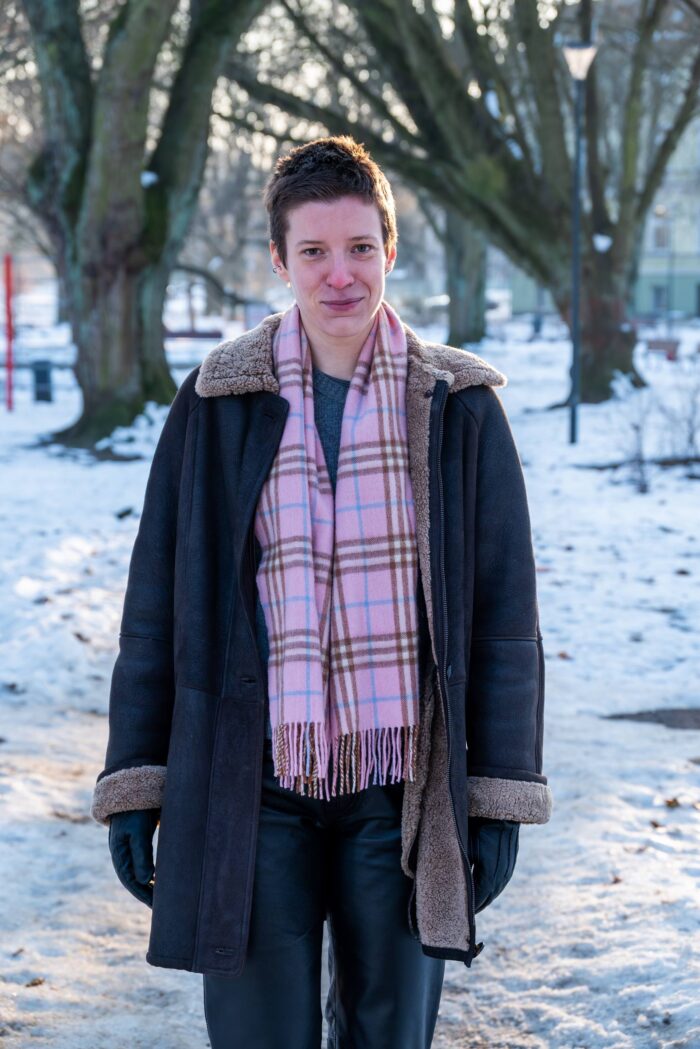
Mariia Bakalo is a Ukrainian choreographer, performer, movement researcher and educator. She studied choreography and philology and holds an MFA in Experimental Choreography from the University of California, Riverside. She is a certified DanceAbility teacher. Combining contemporary dance, contact improvisation and somatic practices, her work addresses touch, care, war and the role of art in times of crisis and human suffering. Mixed-ability dance and performance lectures incorporating autoethnographic elements form an important part of her practice. She has received a Presidential Artist Scholarship in Ukraine and a danceWEB Scholarship at ImPulsTanz. She has participated in residency programmes including Culture Utopias in Wrocław and Bucharest and Dreaming 90s at HELLERAU. Originally from Crimea, she has lived and worked in Lviv since 2014.
Residency was organised thanks to support from ZAiKS
Paula Malinowska
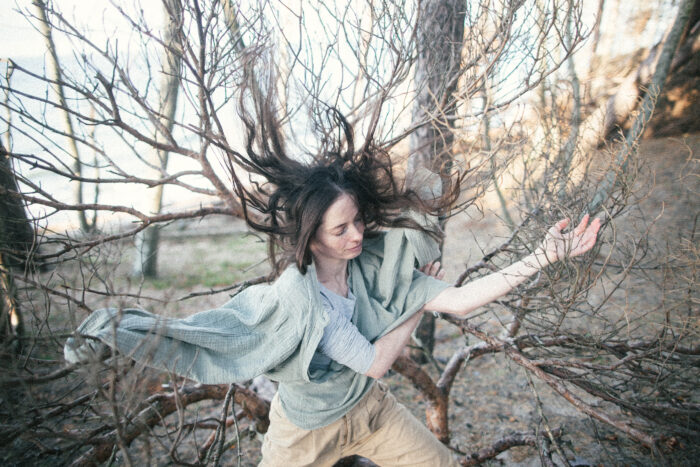
Paula Malinowska is a photographer and 3D artist based in Bratislava, Slovakia. Her work is based on the medium of photography, which she uses to create 3D photogrammetric scans of plant ecosystems. She completed her bachelor’s degree in Jana Hojstričova’s studio at the Department of Photography and New Media and her master’s degree in Martin Piaček’s studio at the Department of Intermedia at the Academy of Fine Arts in Bratislava. She participated on various group shows adn events, including Temporary Connection with a dancing Plant (A Promise of Kneropy, Bratislava, SK, 2022); Kiosk festival 2022 (Žilina, SK, 2022);The Burn Before The Burnout (Karlin Studios, Prague, CZ, 2021); Dissappearing Body (Schaubmar’s Mill, Slovak National gallery, SK 2021); NOWLESSNESS ACT III (Kunsthalle, Bratislava, OFF Festival 2021, SK); Garden Dialogues (Atelier XIII, Bratislava, SK, 2021). In 2022, she participated as a guest artist on Fall Open Studios 2022 in AiR 351 in Cascais, Portugal.
The residency was organised thanks to the support from The International Visegard Fund.
Stony Tellers
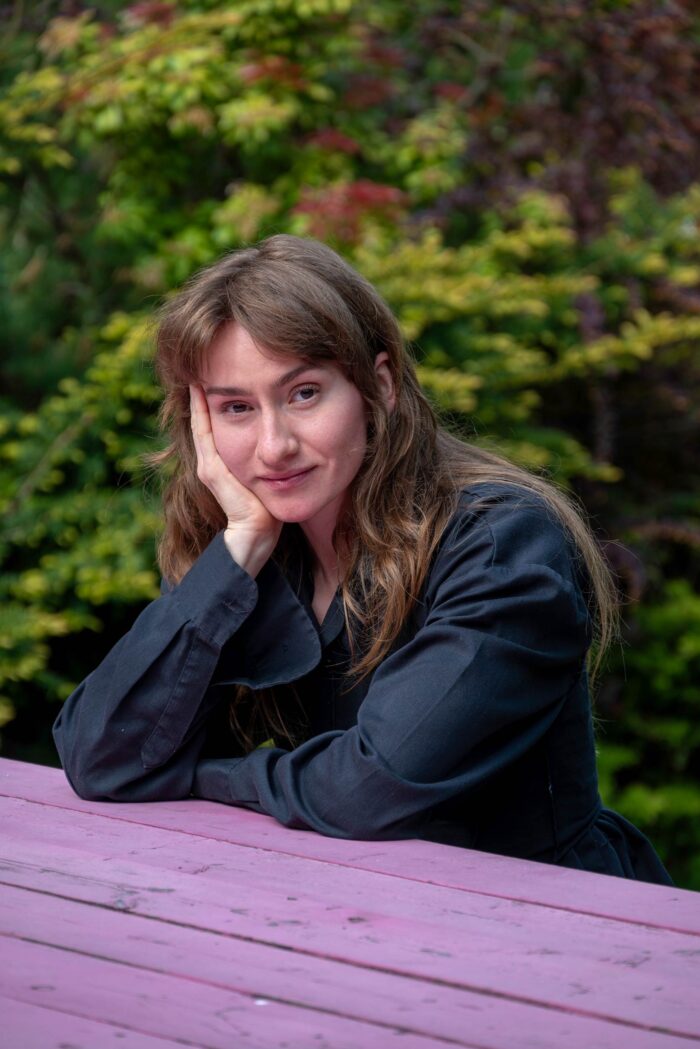
StonyTellers is an art collective founded in 2019, originating from the Sculpture Studio at UMPRUM in Prague. The collective creates installations, performances, text-based projects and social situations, while also drawing on the language and aesthetics of social media. Its practice focuses on building communities based on mutual care, the sharing of resources and interspecies solidarity. Through carefully choreographed encounters, StonyTellers address the precarious conditions of artistic labour, the climate crisis, anxiety and collective ways of responding to contemporary crises. Their projects include “Garden Burnout”, “Globalizační receptář 1.0”, “Signature Drinks”, “Broken Window to the Garden” and “Gossip Stones”. In 2023, the collective received the Jindřich Chalupecký Award. They are based in Prague.
The StonyTellers residency is organised with the support of the Jindřich Chalupecký Society.
Sylwia Górak
Sylwia Górak – painter, performer, and vocalist. She graduated from the Magdalena Abakanowicz University of the Arts in Poznań, earning a degree in painting and drawing (with a focus on performance) under the supervision of Prof. Jarosław Kozłowski. She has received multiple scholarships, including from Pro Helvetia (Switzerland), CEC ArtsLink (New York), and Landeshauptstadt Kulturamt (Düsseldorf). She was the winner of the 5th Young Artists Biennale Rybie Oko (2008). Górak has participated in exhibitions and concerts both in Poland and internationally, including at Carnegie Hall in New York. She studied with the world-renowned soprano Prof. Olga Szwajgier. Currently, she is active in acoustic and conceptual performance, possessing a four-octave vocal range. Her recent painting exhibitions have taken place at the Centre for Contemporary Art in Toruń, as well as in Vilnius and Reykjavík. She has also exhibited at the Baltic Gallery of Contemporary Art, the Centre for Polish Sculpture in Orońsko, and the Queens Museum of Art in New York. In 2024, she served as chair of the Katarzyna Kobro Award jury at the Museum of Art in Łódź. She lives and works in Leżajsk.

Teresa Kamińska
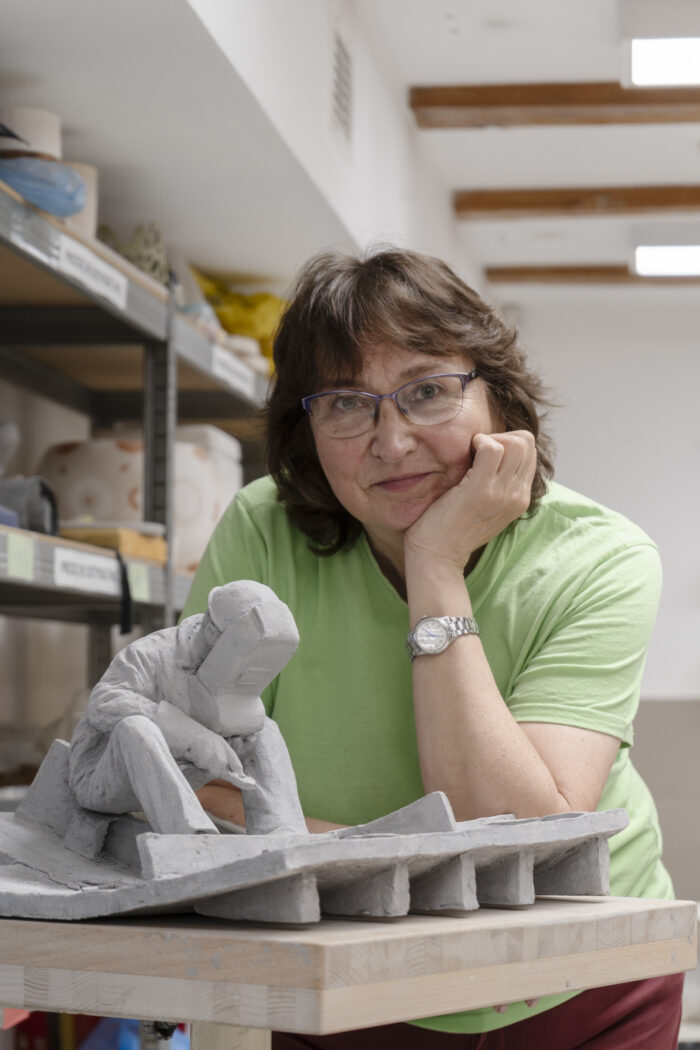
Teresa Kamińska is a ceramic sculptor, biologist and educator based in Ustka. She studied plant and environmental protection at the Agricultural Academy in Szczecin and worked as a biology teacher for nearly thirty years. Her practice combines an interest in organic forms with environmental knowledge, exploring relationships between humans, plants and their surroundings. She is the author of the educational programme Ecology and Tourism and the publication Trees in Ustka, and has initiated several local ecological projects. In recent years, she has developed her sculptural practice at the BGSW ceramics studio in Ustka. In 2026, her work was presented in the solo exhibition Update at the Ustka Cultural Centre.
Residency is part of the programme “Local residents”.
Hyerim Han
Hyerim Han is a visual artist working with film, installation, drawing, and research-based projects. She graduated in Fine Arts from the Seoul National University of Science and Technology. In her practice, she focuses on everyday stories and myths that speak about social and interspecies relations. Her works often explore the experiences and perspectives of older people, addressing issues of labor, the body, social norms, and gestures of care and survival. She has participated in exhibitions at Sogeumnaru SmallArtMuseum in Ulsan (2025), Gyeongnam Art Museum in Changwon, Seo:ro Art Space in Seoul, and Yunsul Art Museum in Gimhae. She completed an artist residency at the Baltic Gallery of Contemporary Art and took part in the exhibition Coalition of Waters (2025). She lives and works in Changwon.

Jean Ulrick Desert
Jean-Ulrick Désert (b. 1960, Port-au-Prince) is a Haitian-born conceptual artist. His work stems from the traditions of socially and culturally engaged conceptual art. Désert studied fine art at Cooper Union and later earned a Master of Architecture from Columbia University, New York.
His works have been presented at the Brooklyn Museum, the Studio Museum in Harlem (NYC), Walker Art Center (Minneapolis), the Havana Biennial, and across Europe — including Haus der Kulturen der Welt (Berlin) — as well as in galleries and public spaces in Amsterdam, Rotterdam, Ghent, Brussels and Dakar.
Désert is also active in academia. He has taught and served as a visiting critic at universities in the United States (Princeton, Yale, Columbia), Germany (Humboldt University) and France (École supérieure des Beaux-Arts). He is a recipient of awards including the LMCC Lower Manhattan Cultural Council (USA), Cité des Arts (France), and the WiDiMibaWi Art Prize 2022/23 (Germany).

Nayaa Krugman
Nayaa Krugman is a Zapotec-Jewish/Mexican-American curator, cultural worker, and editor centered with SAVVY Contemporary: The Laboratory of Form-Ideas, in Berlin. Her practice moves through sound, spirit, storytelling, and collaboration, approaching curatorial work as a means of channeling embodied knowledge across temporalities and geographies. In partnership with artists and transdisciplinary makers, she tends to spaces of epistemic exchange and anti-hegemonic disobedience. Refusing the impositions of dominant history, their work dwells in diasporic in-betweens and liminal spaces —where relation is a method, unlearning a ground, and art a gesture of meaning-making to reimagine otherwise. They completed an artist residency at the Baltic Gallery of Contemporary Art and took part in the exhibition Coalition of Waters (2025).

Maja ∀. Ngom
Maja ∀. Ngom is a Poznań-born multidisciplinary artist working with photography, installation, film, text and sculpture. She holds degrees in photography from the Royal College of Art in London and University of the Arts London, as well as in ethnolinguistics from Adam Mickiewicz University. She is also a participant in the Institute for Postnatural Studies programme (2025).
In her work, she combines diverse materials and natural elements to create imagined worlds inspired by embodied experience, generational memory and racial discourse. She examines the complexities of multiethnicity and the underrepresentation of marginalised bodies, substituting their absence with fictional narratives and fantastical motifs.
Her works have been shown at the Royal College of Art (London), the Museum of Art in Łódź, and the Biennale Zielona Góra Returning to the Future. In 2021, she presented the solo exhibition All That They Hide From Themselves at Centrala Space (Birmingham). In 2019, she published the photographic essay The Sweet Taste of Otherness in Obieg.
She lives and works in London.
Magdalena Starska
Magdalena Starska (b. 1980, Poznań) is an artist working with drawing, installation, and performance. She graduated from the University of the Arts in Poznań and was a member of the artistic collective Penerstwo. Working across various media, she allows her sculptures and performances to merge and evolve, while her drawings resist being defined as autonomous works. She draws on materials from her immediate surroundings, using simple objects to affirm everyday gestures and sensations. Her practice often engages ephemeral phenomena such as flickering light or materials that change their physical state. Starska also creates subtle interventions in public space, discreetly involving passers-by in events unfolding between the private and the public. She participated in the Each Other and Dobro-Stan programmes at the Baltic Gallery of Contemporary Art in 2025. She lives and works in Poznań.

Parul Sinha
Parul Sinha jest artystką wizualną, która ukończyła studia magisterskie z malarstwa na College of Art w Delhi (2016). Tworzy przede wszystkim akwarele, w których skupia się na narracjach ekologicznych i tematach miejskiej alienacji. Brała udział w projekcie książkowym opublikowanym w Mini-Majelis w ramach Documenta Fifteen w Kassel. Prezentowała swoje prace na wystawie indywidualnej w Metta Contemporary w Navi Mumbai (2018) oraz w wystawach zbiorowych w Clark House Initiative w Mumbaju (2017) i w galerii Latitude 28. Oprócz wystaw współtworzyła również ilustracje i komiksy o tematyce ekologicznej. W swojej praktyce artystka stara się zwrócić uwagę na pomijane wątki ekologiczne i relacje społeczności z bioróżnorodnością, które są w stanie ciągłego zagrożenia. W swoich wizualnych opowieściach Parul Sinha bada w jaki sposób wrażliwość środowiskowa kształtowana jest przez wzorce konsumpcji i podkreśla rosnącą degradację ekosystemów w obliczu zmian klimatycznych i ekspansji miast.

Paweł Matyszewski
Paweł Matyszewski (b. 1984, Białystok) is a painter, author of objects and installations, and a gardener. He graduated from the Faculty of Painting at the University of the Arts in Poznań in 2009 under Professor Piotr C. Kowalski, and obtained his PhD in 2021 under the supervision of Dr Dominik Lejman at the same institution. His works have been presented in Poland, Austria, Belarus, the Czech Republic, Denmark, Estonia, France, Georgia, Spain, Lithuania, Germany, Serbia, Hungary, and the United Kingdom. He has been awarded scholarships from the National Centre for Culture (2014) and the Ministry of Culture and National Heritage (2012, 2024), and received numerous art prizes, including at the Painting Biennale Bielska Jesień (2009, 2012) and the Young Art Biennale Rybie Oko (2013, 2015). His practice explores the broad notion of marginal phenomena and behaviours situated at the intersection of culture and biology. He combines the language of realism and abstraction, painting and object. His solo exhibition With Sand in My Teeth was presented at the Baltic Gallery of Contemporary Art in 2025.

Ranjit Kandalgaonkar
Ranjit Kandalgaonkar’s art practice primarily comprises a lens directed at the urban context of cities. His city-specific projects map vulnerability within redevelopment strategies of urbanisation, combative histories of reclamation/speculation or record timelines and blindspots -alternate markers of a city that’s unraveling. His works respond to research conducted on modes of philanthropy practiced within community-based trusts; a subaltern imagination of the Bombay plague of 1896; subsequent loss of flora/fauna in colonial Bombay; and a long-term project on latter day 20th century ship-breaking and invisible shipping infrastructures. They attempt to unlock trapped data through placing the work in the context of an unseen social history. Awards & fellowships include; Majlis Visual Arts fellowship, UDRI Architectural fellowship, The Leverhulme Trust Artist in Residence, The Wellcome Trust Seed award, SAI Harvard University Artist Residency and the Gasworks Artist residency. His work has been exhibited at UCL-Cities Methodologies, Bergen Assembly Art & Research Triennale, Melahuset/OCA Norway, Colomboscope, Warehouse421, the Wellcome Collection and other galleries locally and internationally. He completed an artist residency at the Baltic Gallery of Contemporary Art and took part in the exhibition Coalition of Waters (2025). He lives and works in Mumbai, India.

Roberto Uribe Castro
Roberto Uribe Castro studied architecture in Bogotá and fine arts in Berlin. He has worked as an independent architect and consultant on the first urban development plan for Bogotá that addressed environmental challenges. He has collaborated on major artistic projects with artists such as Mona Hatoum and Doris Salcedo.
His artistic practice focuses on the urban environment as a historical document, creating installations that examine the relationships between architecture, politics and history. He has received a Berlin Senate grant and was a finalist in art competitions in Germany and Ireland.
Roberto is also co-founder of CC_Berlin, a platform supporting rural communities in Mexico and Colombia. He lives and works in Berlin.

Ru Kim
Ru Kim is an artist who enjoys using performance and video installations to question the use of art in resisting and reappropriating perpetuations of violence generated by patriarchal, imperial, and colonial ideologies of domination. Employing various media such as video, photography, sound, performance, installation, and text, they seek to develop forms that challenge binaries and fixed identities. Moving through their own fluidity in language, culture, and identity, Ru Kim is nourished by hydro-, Black, and queer feminist theories to lead deconstructivist analyses of oppressive, racist and colonial representations. Recent projects focus particularly on stories told through the lens of the more-than-human witness, strategies of water as seen through a hydrofeminist lens, documentation of queerness in Korean history, and archives revealing the “Asian” construction enacted by the Western gaze. They completed an artist residency at the Baltic Gallery of Contemporary Art and took part in the exhibition Coalition of Waters (2025). They live and work in Seoul.

Tanja Ostojić
Tanja Ostojić is a visual artist and performer whose interdisciplinary practice also includes teaching and research. She is recognised as one of the pioneers of institutional critique from a gender perspective and as a key figure in socially and politically engaged feminist art, particularly in the contexts of migration and gender issues. She graduated from the University of Arts in Belgrade, École Régionale des Beaux-Arts in Nantes, and the Graduate School at Universität der Künste in Berlin. Her work has been presented internationally, including at the Venice Biennale, Performa, and the Busan Biennale. She lives and works in Berlin.

Theresa Weber
Theresa Weber graduated from the Kunstakademie Düsseldorf and the Royal College of Art, London. She combines collage, textile installation and collaborative performance, seeking to question existing power hierarchies and fixed categorizations. In her perspective as an artist with a Jamaican, German and Greek family background, her practice often refers to Caribbean discourse, existing mythologies and historical research fields. Her works consists of culturally loaded materials that engage with the body from an de-colonial perspective. Represented through contemporary body-marks and archival techniques, her practice exemplifies the constant transformation within every tradition. On the dynamic field between transparency and opacity, Weber’s practice creates space for strength and resilience through nuance and fragility. She completed an artist residency at the Baltic Gallery of Contemporary Art and took part in the exhibition Coalition of Waters (2025). She lives and works in Berlin.

Zai Xu
Zai Xu, born in 1998, is an interdisciplinary artist, curator and producer working with writing, photography and mixed-media installation. Their practice explores the experience of growing up as a person of colour in a predominantly white society, feelings of vulnerability, stress and anxiety, and queer perspectives. In 2018, they founded SVĚTOVA 1, an independent artist-run space in Prague focusing on emerging art, socio-political issues and experimental exhibition formats. As a co-creator of its programme, they have co-produced more than 24 exhibitions and 70 public events. Xu also initiated “As We Grow”, an educational and research programme for early-career artists, the queer and feminist knowledge festival “kvír vědomostí”, and “swimming pool”, a regular gathering of Prague’s independent art spaces. They also co-created “Say My Name”, a zine mapping the Czech queer art scene. Their text “Why Am I so White?” was published by tranzit.cz in the book “Soft Spots” as part of the 2022 Biennale Matter of Art. They live and work in Prague.
The residency is organised as part of the “Kurort Ustka” project, co-financed by the Minister of Culture and National Heritage under the “Visual Arts 2026” programme.
Zhenia Stepanenko
Zhenia Stepanenko is a Ukrainian artist living and working in Berlin. Her practice encompasses video, installation, performative, and musical projects. Stepanenko’s work explores tensions between introspection and social phenomena, drawing on intuitive working methods and adapting the medium to the specific project. She studied book design at the Ihor Sikorsky Kyiv Polytechnic Institute and at the Kyiv Academy of Media Arts. Her work has been presented in numerous exhibitions in Ukraine and abroad, including at Voloshyn Gallery, Stadtmuseum Berlin, Kvost, and Pinchuk Art Centre. She is the co-founder of the musical-performance collective Poison Dog Saliva and the initiator of culinary-related projects, including Kreepy Bakery and Ohirok & Pomidor.

Rooms BGSW/USTKA
Who are the guest rooms for?
The guest rooms at BGSW are intended primarily for artistic residencies and residencies centred on repose. Invited guests are welcome to bring children and pets at no extra charge.
Who else can stay in the rooms, and under what conditions?
We warmly invite creative individuals to make use of our accommodation offer. We provide lodging for both individuals and larger groups, also on preferential terms. We understand that needs vary, so in special cases it is possible to further reduce the fees. More information can be found below.
Rules for Using the Guest Rooms at BGSW / USTKA (excerpt from the regulations)
1.The guest rooms at the Centre for Creative Activity are available to individuals invited by BGSW, artists and their partners, as well as their dependants and children (stays with pets are possible upon prior arrangement).
2.The accommodation fee is 150 PLN per person per night.
3.Preferential rates apply to participants of outdoor workshops lasting at least 3 days (95 PLN per person per night, for groups of 10–16).
4.A reduced rate is available for individual week-long stays by artists (500 PLN for 7 days).
5.Guests invited by BGSW for ongoing projects – including residencies centred on repose – as well as children under the care of artists and household pets, may stay free of charge.
6.Guests are required to pay the local spa fee (not applicable to individuals invited by BGSW).
Reservations
Phone: +48 59 842 56 74
E-mail: [email protected]